Nano Emulsified Edibles: Why They Hit Faster and Harder
Nano Emulsified Edibles: Why They Hit Faster and Harder
Nano-emulsified edibles use tiny, water-compatible cannabinoid droplets to deliver faster and more predictable effects than conventional oil-based edibles. Most users feel effects within 10 to 30 minutes, compared to the 30 to 120 minute wait for traditional gummies. The catch: federal regulators haven't standardized nano labeling, so a Certificate of Analysis and clear method disclosure matter more than the word "nano" printed on the package.
TL;DR:
- Nano-emulsified edibles deliver effects within 10 to 30 minutes, significantly faster than the 30 to 120 minutes typical of traditional gummies.
- The manufacturing process involves advanced techniques like high-pressure homogenization, ultrasonication, or microfluidization, with transparency on methods indicating better quality.
- Consumers should verify the product's COA, manufacturing method, and surfactant ingredients, as stability and effectiveness depend heavily on proper formulation.
- Nano products tend to be priced higher due to more complex manufacturing, but higher bioavailability can make them more cost-effective per effective dose.
- Speed and predictability are major advantages, but shorter effect durations and quality concerns require careful dosing and sourcing from transparent, tested brands.
What Does "Nano-Emulsified" Mean for Edibles?
A regular cannabis edible relies on an emulsion. Oil-based THC gets suspended in a gummy base or beverage, but oil and water don't naturally mix, so the droplets stay relatively large and clump together. Your body has to break that fat down slowly through digestion before cannabinoids reach the bloodstream, which is why traditional edibles take so long to kick in.
A nano-emulsion shrinks those cannabinoid droplets down to under 200 nanometers, roughly a thousand times smaller than what you'd get with a standard oil infusion. That size shift changes everything about how the product behaves. Droplets that small disperse evenly in water instead of separating, which is why nano-infused seltzers and shots don't need constant shaking. It also means your body doesn't have to work as hard to absorb them; smaller particles pass through the gut lining and into the bloodstream faster, and some can even start absorbing sublingually before you swallow.
That's why nano-emulsion technology shows up across so many product categories now:
- Gummies and chews formulated to hit faster than traditional counterparts
- Beverages and seltzers that stay clear or lightly cloudy instead of separating
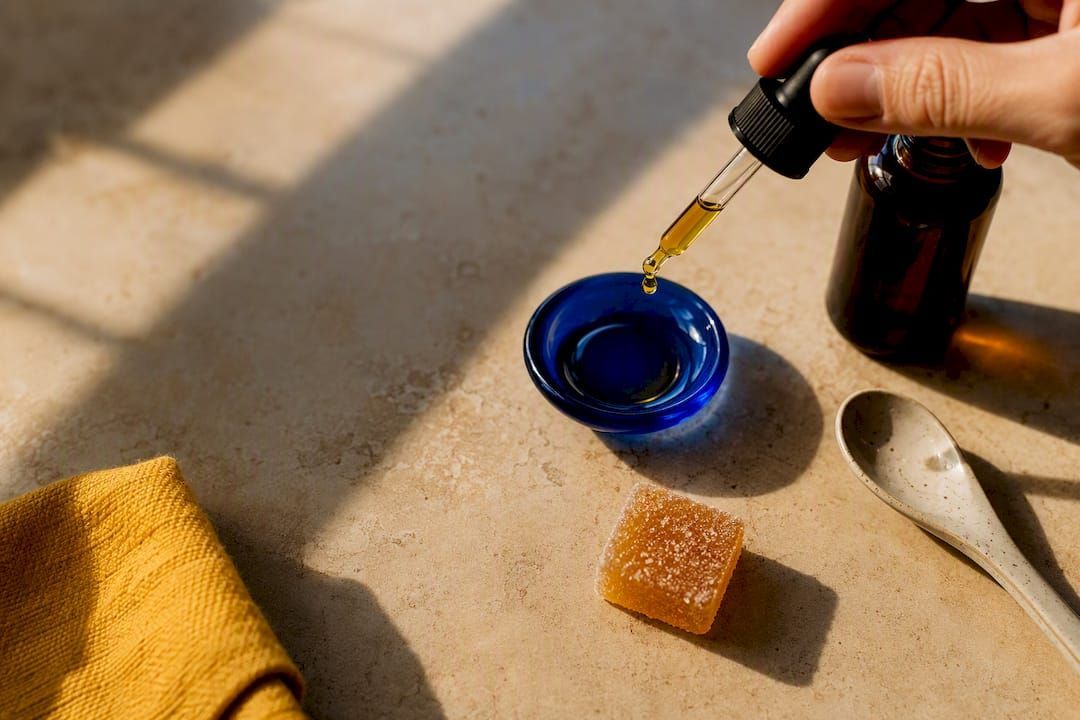
- Tinctures designed for quicker sublingual uptake
- Tablets and capsules built around water-dispersible cannabinoid powders
If you want a broader look at how different edible formats compare on effects and timing, this guide to cannabis edible types and effects breaks it down further.
How Do Manufacturers Actually Make Nano-Emulsions?
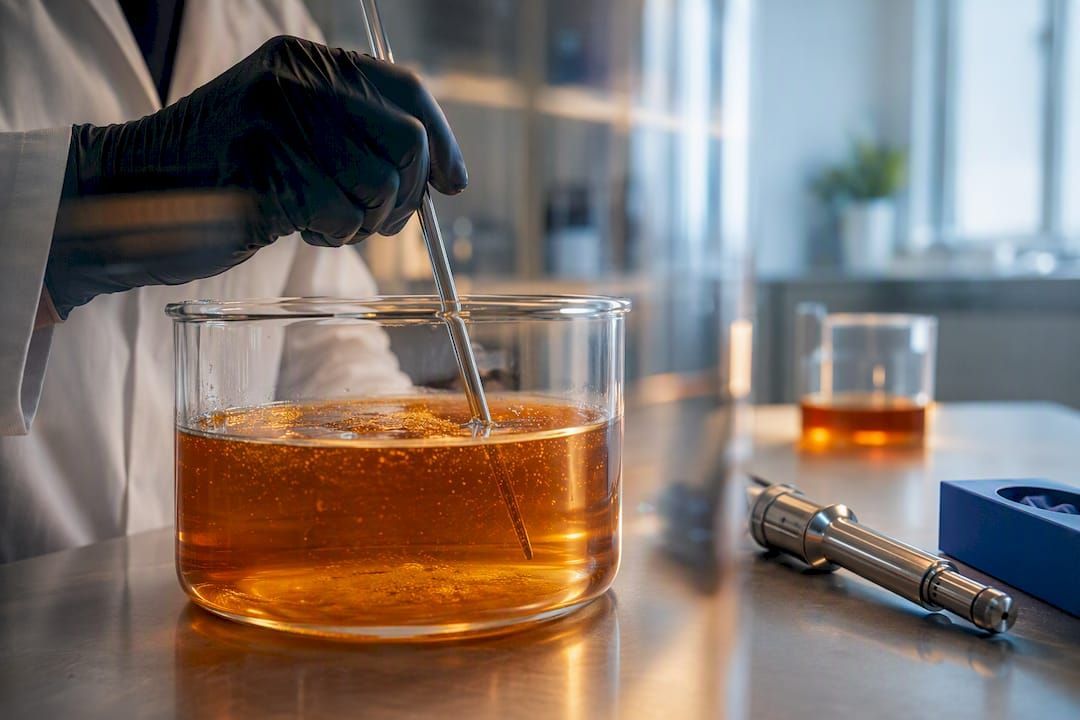
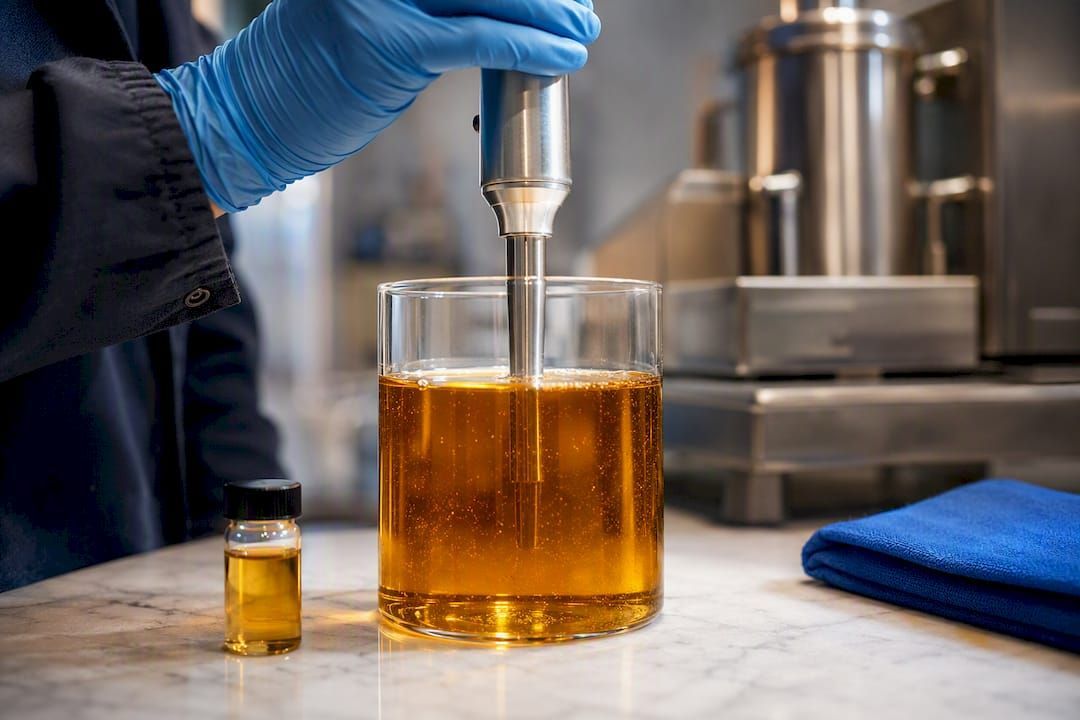
Getting cannabinoid droplets down to nanoscale isn't a matter of stirring harder. It takes real mechanical or acoustic force, and manufacturers generally lean on three approaches.
- High-pressure homogenization forces the oil-water mixture through a narrow valve at extreme pressure, shearing droplets down to size. It's the most common industrial method because it scales well.
- Ultrasonication uses sound waves to generate microscopic bubbles that collapse violently, tearing droplets apart. It's precise but harder to scale to large production runs.
- Microfluidization pushes the mixture through microchannels at high velocity, producing very uniform droplet sizes. These three methods dominate cannabis nano-emulsion manufacturing across the industry.
None of it works without the right emulsifier holding the droplets apart once they're formed. Surfactant choice determines whether that nano structure survives on a shelf for months or collapses within weeks, since the wrong surfactant system lets droplets re-merge and settle out.
Pro Tip: Look for brands that name their manufacturing method (ultrasonication, homogenization, or microfluidization) directly on the label or COA. Vague marketing that just says "nano-infused" without any process disclosure is often a shortcut past quality control, not a sign of superior tech.
How Fast Do Nano Edibles Kick In Compared to Traditional Ones?
Industry and lab reporting consistently puts nano-emulsified onset in the 10 to 30 minute range, versus 30 to 120 minutes for oil-based traditional edibles. That gap comes down to absorption pathway, not potency.
By the numbers: manufacturers sometimes claim bioavailability increases of 3 to 5 times over standard oil-based formats, though the real-world figure depends heavily on the specific formulation and testing method used.
Here's what that means for how the high actually feels:
- A 10 mg nano gummy can feel noticeably stronger than a 10 mg traditional gummy, because more of the dose actually reaches your bloodstream instead of getting lost in digestion.
- Formulation also affects how much THC converts to 11-hydroxy-THC, the more sedating metabolite produced when your liver processes traditional edibles; nano formats can shift that ratio, producing effects that feel closer to inhalation.
- Duration tends to run shorter than slow-release traditional edibles, so don't expect the same six-to-eight-hour tail.
That last point catches people off guard. Faster onset often trades off against a shorter overall window, which is worth knowing before you plan your evening around it.
What Should You Check on a COA Before Buying?
A Certificate of Analysis is the only real proof that a nano product is what it claims to be. Skip the marketing copy and look for lab results covering potency (does the mg on the label match the mg in the batch), residual solvents, heavy metals, and microbial contamination. Nano-emulsified products carry an extra wrinkle traditional edibles don't: formulation stability.
Because nano droplets are held apart by a surfactant system, moisture exposure and oxidation can cause that structure to break down faster than a standard oil-based product. Stability depends heavily on the surfactant system and manufacturing process, and an inadequate surfactant load can cause the emulsion to separate well before the printed expiration date. Store nano beverages and tinctures away from heat and light, and don't assume a product with no visible separation is automatically stable. Nano emulsions can fail invisibly at the molecular level before you ever see clumping.
A few red flags worth walking away from:
- No COA available on request, or a COA that's clearly outdated
- "Nano" printed on the label with zero method or surfactant disclosure
- Storage instructions missing entirely from beverages or tinctures
On the regulatory side, the FDA hasn't issued comprehensive nano-emulsion labeling guidance at the federal level, which means state testing programs and brand transparency are currently doing the heavy lifting on consumer protection.
How Should You Choose and Dose Nano-Emulsified Edibles?
Choosing a nano product comes down to verifying claims, not trusting labels. Run through this before you buy:
- Confirm the COA exists and is current. Batch-specific, not a generic product page.
- Check for method disclosure. Ultrasonication, homogenization, or microfluidization named somewhere, even in fine print.
- Read the ingredient list for a named surfactant. Lecithin alone is often a weak choice for stable nano formulations, so look for products that specify a more robust emulsifier system.
- Confirm dose per serving is clearly marked , not just total package potency.
- Look for a shelf-life or "best by" date tied to the batch, not a blanket claim.
Because nano formats hit faster and can feel stronger at the same labeled dose, start conservatively with a low THC equivalent dose for a first try, especially if you're new to nano products or have low tolerance. Wait a full 30 to 45 minutes before considering more, even though effects may start sooner. Low-dose, transparent-onset formats work best for microdosing, so if that's your goal, look specifically for brands offering 1 to 5 mg options.
Pro Tip: Ask a budtender or brand directly whether their COA covers the specific batch you're buying, not just a representative sample. Batch-level testing is the difference between a real safety check and a marketing formality. For dosing timing across formats more broadly, this guide to using edibles effectively is worth a read too.
How PotMates Vets Fast-Acting Edibles
This piece was written by Hammond, drawing on published lab and industry research into nano-emulsion pharmacokinetics and manufacturing. Standard practices in the industry include checking for COA availability and ingredient transparency before listing edibles. Browse the edibles category to see nano and traditional formats side by side.
What Side Effects Should You Watch for With Nano Formats?
Faster absorption cuts both ways. The same mechanism that gets cannabinoids into your bloodstream quicker also means you feel effects, good and bad, sooner and sometimes more intensely than a labeled dose might suggest. Overconsumption symptoms with nano products tend to arrive in a tighter window: rapid heart rate, anxiety, dizziness, or nausea can show up within 20 to 30 minutes rather than creeping up over an hour or two.
That speed changes the practical risk. With a traditional edible, someone who feels nothing after 45 minutes might take a second dose, not realizing the first hasn't peaked yet, and end up with two doses stacking at once. Nano's quicker onset actually reduces that particular mistake. But it also means less time to course-correct if you've misjudged your tolerance, since the window between "feeling fine" and "feeling too much" compresses.
Formulation quality plays into health considerations too. A poorly stabilized nano-emulsion, one where the surfactant system has broken down, may deliver an uneven dose across a batch, meaning one gummy from a package hits harder than the next. This is exactly why COA-verified potency testing matters more for nano products than for traditional ones, where absorption is slower and more forgiving of small dosing inconsistencies.
If you're sensitive to caffeine, alcohol, or other fast-acting substances, treat a first nano edible with the same caution. Start low, wait the full window before redosing, and avoid combining with alcohol until you know how your body responds specifically to a nano format.
Do Nano-Emulsified Edibles Cost More Than Traditional Ones?
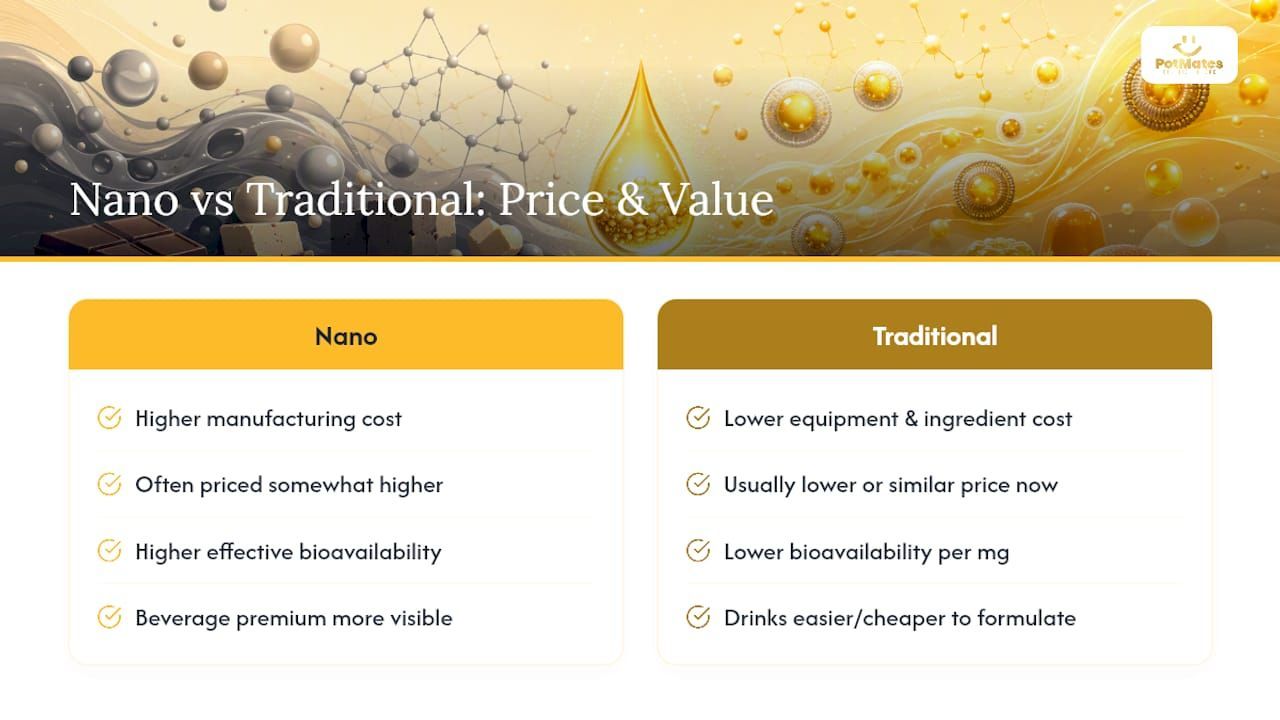
Nano-emulsified products tend to be priced somewhat higher than traditional oil-based edibles, and the manufacturing process explains why. Ultrasonication and microfluidization equipment cost more to install and run than standard infusion methods, and the surfactant systems required for stable nano formulations are pricier than the basic fats and oils used in conventional gummies.
That said, the price gap has narrowed as nano technology has become more common across the edibles category. A few years ago, nano products sat firmly in a premium tier; now you'll find nano-emulsified gummies and beverages competing directly with traditional products in similar price brackets, particularly from brands producing at scale.
Where the value math gets interesting is per-milligram efficiency. Because nano formats deliver higher effective bioavailability, a 5 mg nano gummy may produce effects comparable to a 10 mg traditional gummy for some users. If that holds for your body chemistry, a nano product priced 20% higher than its traditional counterpart could still work out cheaper per dose you actually feel. It's not a guarantee, since individual absorption varies, but it's worth factoring into any straight sticker-price comparison.
Beverages are where the premium is most visible. Nano-infused drinks tend to cost more than a comparable traditional THC beverage, partly because water-compatible formulation is technically harder to pull off than a gummy base. If budget matters more than onset speed, traditional edibles remain the more economical entry point, especially for occasional or higher-tolerance users who don't need the faster timeline.
What Are Consumers Saying About Nano-Emulsified Products?
Feedback on nano-emulsified edibles clusters around a few recurring themes once you look past individual product reviews. Speed is the most consistently praised feature. Users switching from traditional edibles regularly report being caught off guard by how quickly nano products hit, in a good way, especially those who'd previously waited over an hour for effects and gave up or redosed too early.
Predictability is the second major theme, and it's arguably more important than speed alone. Traditional edibles have a reputation for inconsistent timing. One night it kicks in at 40 minutes, another night it takes two hours depending on what you ate that day. Nano formats tend to draw praise for narrowing that variance, since water-compatible absorption is less dependent on digestion timing than fat-based absorption.
The negative feedback tends to cluster around two issues: price and duration. Some reviewers feel nano products don't justify their premium, particularly when a traditional edible at a lower price point gets them to a similar place, just slower. Others miss the longer tail of a traditional edible's effects, especially for sleep-focused use cases where a shorter, sharper high isn't what they're after.
Reviews also skew more critical when a product fails to disclose its testing or method, even if the effects themselves are strong. Cannabis consumers researching nano products tend to be more label-literate than average, and a missing COA or vague "nano-enhanced" claim shows up in feedback as a trust issue well before it shows up as a potency complaint.
Where Is Nano Cannabis Technology Headed?
Nano methods are only going to spread further, and beverages are the clearest evidence of that. A format that was borderline impossible to execute well with oil-based cannabinoids now works because tiny droplets disperse in water instead of floating on top. Expect more low-dose, fast-acting products aimed at microdosing rather than the "get as high as possible" market nano first launched into.
What the space genuinely needs is standardized testing language on labels, not just a COA buried in a QR code. Right now, "nano" means wildly different things depending on which brand prints it. Consumers should stay excited about the technology, but that excitement works best paired with a habit of checking the actual paperwork instead of taking the label's word for it.
— Hammond
Find COA-Verified Nano Edibles Through PotMates
Reading a Certificate of Analysis shouldn't be a prerequisite for buying a gummy, but until federal nano labeling standards catch up, it's the smartest habit a cannabis consumer can build. Potmatespdx is built around that same principle: every product on the menu is curated with ingredient transparency and lab documentation in mind, not just flashy packaging claims.
Browsing for a fast-acting option can feel like a guessing game when every brand claims to be "nano-infused." That's where the Virtual Budtender comes in. Ask it directly about onset time, dosage per serving, or whether a specific product discloses its manufacturing method, and it'll point you toward options that match what you're actually looking for. If you'd rather browse on your own, head straight to the edibles delivery menu to compare nano and traditional formats side by side, check COAs before you check out, and get discreet delivery scheduled around your day.
Sources
This article is general information, not a substitute for advice from a qualified doctor. Consult a qualified healthcare professional about your own circumstances before acting on anything here.
FAQ
Are Nano Edibles Stronger Than Traditional Edibles?
They can feel stronger at the same labeled dose because higher bioavailability means more of the THC actually reaches your bloodstream, though the actual potency multiplier varies by formulation and manufacturing method.
How Fast Do Nano Edibles Kick In?
Most nano-emulsified edibles produce effects within 10 to 30 minutes, compared to 30 to 120 minutes for traditional oil-based edibles.
What Does "Nano" Mean on an Edible Label?
It refers to cannabinoid droplets processed down to under 200 nanometers in size, allowing them to disperse in water and absorb faster than standard oil-based cannabinoids.
Is Nano Emulsion Safe to Consume?
Nano-emulsified cannabinoids are generally consumed safely when properly formulated and lab tested, but formulation quality varies, so a current COA covering potency and contaminants is the best safety confirmation available to shoppers.
Do Nano Edibles Cost More Than Traditional Ones?
Nano products often carry a modest price premium due to specialized equipment and surfactant systems, though the gap has narrowed and per-dose value can favor nano formats for users who feel effects at lower milligram counts.
Recommended